 English
 Español
 日本語
日本語 Français
 Deutsch
 Tiếng Việt
 العربية
 Portugues
 lingua italiana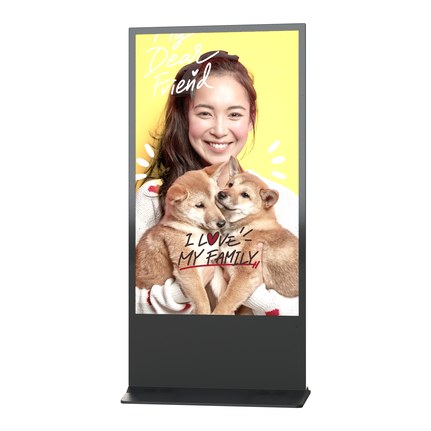

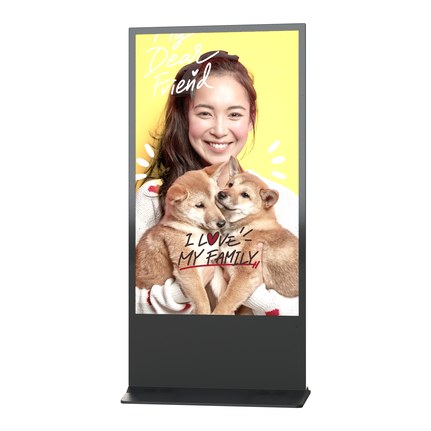
What it is: A 75-inch floor-standing display built for AI conversation rather than playback. Display, computer, camera, microphone array and speakers are integrated into one unit, so an AI assistant, digital human or smart Q&A application runs on the screen itself — no external PC, no separate camera bracket, no add-on speaker.
What is inside the unit
- 75"4K panel — 3840 × 2160, 500 cd/m², mounted portrait.
- AG capacitive touch — anti-glare glass as standard, 10-point multi-touch.
- Android or Windows computer — selectable, built in, so AI software runs locally on the display.
- 12MP auto-focus camera — high-definition capture for face detection and vision-based interaction.
- 10-element AI microphone array — beamforming and noise reduction for voice pickup in a noisy public space.
- Built-in speakers — mounted in the base, directed at the person standing in front of the unit.
- Floor-standing body with casters — white or black housing; no wall fixing or civil work, and the unit can be repositioned.
The interaction envelope — the numbers that decide where it works
For a conversational display, the mechanical dimensions matter less than the volume of space in which a person can actually be seen and heard. These figures come from the mechanical drawing:
| Camera field of view | 78° |
| Camera downward tilt | 15° |
| Camera mounting height | 1,700 mm from floor |
| Microphone pickup angle | 60° horizontal |
| Microphone pickup distance | 1,500 mm |
What this means in practice: the unit is designed for one person standing roughly within 1.5 m, facing the screen. It is a one-to-one conversation station, not a far-field announcement screen. Plan the floor layout so that a visitor naturally stops inside that cone — in a wide lobby, an approach path or a floor marking does more for usable interaction than any specification change.
Specification
| Screen size | 75 inch, portrait |
| Resolution | 3840 × 2160 (4K) |
| Brightness | 500 cd/m² |
| Touch | Projected capacitive, 10-point, AG glass standard |
| Computer | Android or Windows, selectable |
| Camera | 12MP auto focus |
| Microphone | 10-element array, beamforming and noise reduction |
| Audio | Built-in speakers in the base |
| Housing | White or black, floor standing with casters |
| Overall size | 2,000 mm (H) × 1,006.5 mm (W), panel depth 63.8 mm |
| Base | 560 mm deep × 65 mm high |
| Active area | 1,650 mm × 929 mm |
| Top of image | 1,700 mm from floor |
500 cd/m² with anti-glare glass is an indoor specification. It suits a lobby, a store interior, a mall concourse or an exhibition hall. It is not intended for a position in direct sunlight or immediately behind shop-front glazing — that is a different product class.
What runs on it
The unit ships as hardware with an Android or Windows computer inside; the AI application is chosen by the project. Typical deployments run a conversational assistant with a digital human avatar, a smart Q&A knowledge base, or a product-guide application. Because the computer is a standard Android or Windows environment, software that already runs on a tablet or a PC runs here without porting.
Ask at specification stage: which AI application will run on it, whether it needs cloud access or must work offline, and what network the site can provide — a conversational assistant that calls a cloud model behaves very differently on a venue guest network than on a wired line. The Android or Windows choice follows from that answer, not from preference.
Where it fits
- Retail stores — AI shopping assistant at the entrance or beside a product wall.
- Hotels and lobbies — digital concierge for check-in guidance, facilities and local information.
- Shopping malls and public buildings — information assistant and wayfinding that answers spoken questions.
- Exhibitions and showrooms — interactive product guide that handles the first round of visitor questions.
The casters matter for the exhibition case: the unit can be moved between stands and events without reinstallation.
Checklist before you order
- Where will the person stand? Confirm the 1.5 m / 60° pickup cone fits the floor layout.
- Ambient noise level at the location — beamforming helps, but a concourse at peak hour is a different problem from a hotel lobby.
- Android or Windows — decided by the AI application.
- Network: wired, venue Wi-Fi, or offline operation.
- Lighting behind the visitor — strong backlight works against face detection.
- Ambient light on the screen — 500 cd/m² is an indoor figure; keep the unit out of direct sun.
- Floor space: 1,006 mm wide × 560 mm deep, plus standing room in front.
- Housing colour: white or black.
How EKAA approaches AI interaction hardware
EKAA designs and manufactures its own commercial displays in Guangzhou, and this unit is built on the same indoor interactive line. Because mechanical design, assembly and testing happen in house, the camera position and angle, the microphone arrangement, the computing module and the housing finish can be configured to the installation rather than taken from a fixed catalogue, and the mechanical drawings come from the team that builds the unit. Products carry CE, RoHS and FCC certifications depending on the line.