
 English
 Español
 日本語
日本語 Français
 Deutsch
 Tiếng Việt
 العربية
 Portugues
 lingua italiana
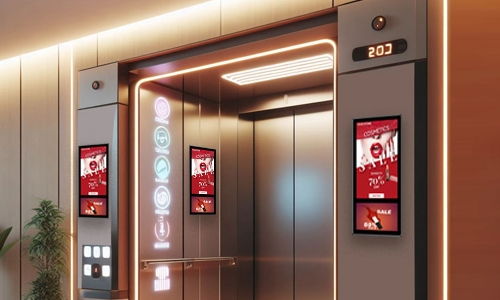
Short answer: A lift car is a small, brightly lit, vibrating steel box that people stand in for thirty seconds at a time. That combination — short dwell time, close viewing distance, constant movement, and no room behind the wall — is what makes elevator displays a different product from ordinary indoor signage. Below are the seven things that decide whether an installation works, and the questions to put to a supplier.
1. Where it goes, and how much depth you actually have
There are three usual positions, and each has a different depth budget.
- On the car wall, surface-mounted. Easiest to retrofit, no cutting, but the unit protrudes into a space where people stand — depth and edge design matter.
- Recessed into the car wall. Flush and vandal-resistant, but you need the wall cavity, and in most cars that cavity is a few tens of millimetres at best.
- Above the door or in the door frame, usually a wide bar-type screen. Everyone faces this way, so it gets seen; the constraint is height.
Measure the available depth before choosing a screen. This is the single most common reason a specified unit will not fit.
Ask the supplier: "What is the total depth including the mount and the cable bend radius?"
2. Size and orientation follow the car, not the content
Lift cars are narrow. A 21.5" to 32" portrait panel on the side wall, or a stretched bar display above the door, covers most installations. Larger is rarely better: viewers stand one to two metres away, and a screen that fills the wall forces people to look at it from an angle.
Stretched bar displays — very wide, very short — exist precisely for the space above a door, and they suit a headline plus a ticker far better than a cropped 16:9 panel does.
3. Vibration is the thing that kills installations
A lift car accelerates, decelerates and vibrates dozens or hundreds of times a day, every day. Over a year that is tens of thousands of cycles through a mounting bracket that was designed for a static wall.
What to check: that the mount is rated for a moving installation rather than a domestic VESA bracket, that connectors are secured rather than friction-fit, and that internal boards are mechanically supported rather than hanging on their sockets. Ask specifically whether the unit has been used in lift installations before — this is experience you cannot infer from a datasheet.
Ask the supplier: "Is the mounting designed for a moving car, and how are the internal connections secured against vibration?"
4. Brightness and viewing angle in a small bright box
Lift cars are lit far more brightly than a corridor, and often finished in mirror or brushed stainless steel that throws that light around. A panel that looks fine in an office looks washed out in a car with bright downlights.
Standard indoor brightness is often not enough here. More importantly, viewing angle matters more than in any other indoor application: people stand beside the screen, not in front of it. An IPS-type panel with a wide viewing angle is worth more than extra brightness on a screen people see from 60 degrees off-axis.
Ask the supplier: "What is the rated brightness and the viewing angle, and what do you recommend for a car with mirror finishes?"
5. Noise: a lift car is a quiet room
Thirty seconds of silence with strangers makes any fan audible. A fan-cooled display that is inaudible in an open office is clearly audible in a lift car, and it runs all day. Fanless construction removes the noise, removes the filter that would otherwise clog, and removes the moving part most likely to fail in a vibrating environment. If a supplier offers a fan-cooled unit for a lift, ask what the noise figure is at one metre and who cleans the filter.
6. Getting content into a moving steel box
Lift shafts are hostile to wireless. Mobile signal is often absent, and building Wi-Fi rarely reaches the car reliably. The realistic options are:
- Cabled network through the travelling cable, if the lift contractor will allow a spare pair and the building has a network point in the machine room. Most reliable, usually the most paperwork.
- Local playback from internal storage or a USB stick, updated on a schedule by whoever services the car. Simple, no infrastructure, but someone has to physically visit.
- Mobile data with an antenna run up the shaft. Works in many buildings, fails in some; test before you commit an estate to it.
Whatever the route, agree with the lift maintenance contractor early. Anything attached to the car usually needs their sign-off, and retrofitting a cable later is far more expensive than including it in the plan.
Ask the supplier: "Which content-delivery options does this model support, and what happens to the display if the connection drops?"
7. Power, and who is allowed to touch it
The car has power, but tapping into it is lift-contractor territory in most jurisdictions. Establish before ordering: where the display's supply comes from, whether an isolator is required, who is certified to make the connection, and whether the work has to happen out of hours. In a managed building this often takes longer to arrange than the hardware takes to arrive.
Installation checklist
- Position: car wall surface / recessed / above door
- Available depth including mount: ______ mm
- Screen size and orientation: ______ · portrait / landscape / stretched bar
- Mount rated for moving installation: yes / no
- Rated brightness: ______ cd/m² · viewing angle: ______
- Cooling: fanless / fan (noise at 1 m: ______ dB)
- Content delivery: cabled / local playback / mobile data
- Power source and isolator: ______ · who connects: ______
- Lift contractor sign-off obtained: yes / no
- Access for service: from inside car / from car top
How EKAA approaches elevator displays
EKAA designs and manufactures its own commercial displays in Guangzhou, including the elevator LCD range. Screen size, orientation, depth, mounting arrangement and media player are configured to the car rather than picked from a fixed catalogue, and the units are built without cooling fans, which removes both the noise and the moving part least suited to a vibrating installation. Products carry CE, RoHS and FCC certifications depending on the line.


