
 English
 Español
 日本語
日本語 Français
 Deutsch
 Tiếng Việt
 العربية
 Portugues
 lingua italiana
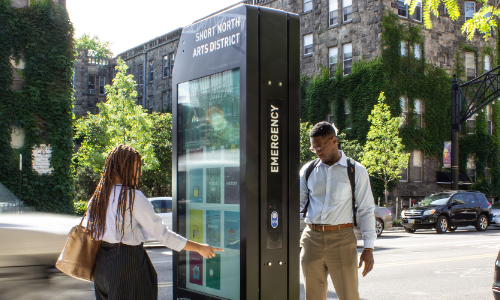
Kiosque de ville intelligentela technologie fait l’objet d’une attention et d’un élan croissants à mesure que de plus en plus de zones urbaines participent au mouvement des villes intelligentes. Ces écrans de kiosque innovants deviennent omniprésents sur les places urbaines, les bâtiments gouvernementaux, les arrêts de bus et les trottoirs, fournissant aux citoyens des informations ponctuelles et spécifiques à un emplacement. Leur présence croissante soulève des questions sur la nature des kiosques intelligents et les avantages qu’ils apportent aux villes et à leurs habitants.
Introduction de SmartCKiosque de ville
UNkiosque intelligentfait référence à un affichage interactif généralement placé dans les espaces publics, conçu pour offrir aux utilisateurs, visiteurs ou passants des informations et des services vitaux. Cel'affichage numérique extérieur est un centre d'information et de communication technologiquement avancé déployé stratégiquement dans les zones urbaines dans le cadre des initiatives de villes intelligentes. Ces kiosques sont équipés d'écrans numériques, d'interfaces interactives et de fonctionnalités de connectivité pour offrir une gamme de services et d'informations aux résidents et aux visiteurs.
Ces kiosques offrent généralement des informations en temps réel sur les événements locaux, les horaires des transports publics, les mises à jour météorologiques, les cartes, les alertes d'urgence et d'autres données pertinentes. Ils peuvent également fournir des services interactifs, tels que la connectivité WiFi, une aide à l'orientation et l'accès aux services ou applications de la ville.
L'objectif principal des kiosques de ville intelligente est d'améliorer la vie urbaine en tirant parti de la technologie pour améliorer la communication, l'accessibilité et l'efficacité globale des services urbains. Grâce à ces kiosques, les villes visent à créer des communautés plus connectées et informées tout en contribuant au concept plus large de construction d’environnements urbains plus intelligents et plus durables.

Qu'est-ce qu'un intelligentVille Kiosk Conçu pour faire ?
Un kiosque de ville intelligente est conçu pour offrir aux citoyens, aux visiteurs ou aux passants un accès pratique à l’information et aux services urbains. Doté généralement d’un écran d’affichage numérique extérieur interactif, un kiosque intelligent permet aux utilisateurs de rechercher et d’obtenir sans effort les informations nécessaires.
Qu'est-ce qu'un intelligentVille Kiosque'sR.gamme de fonctions ?
Le but premier d'unsoi numérique kiosque de serviceest de permettre aux clients d'accomplir de manière indépendante une variété de tâches courantes sans l'intervention d'un employé dédié. Cela couvre les activités.
Orientation– aider les utilisateurs à naviguer dans les rues de la ville et à localiser leurs destinations.
Transport– fournir des horaires et des mises à jour de l'état en temps réel pour les bus, métros, trains et autres modes de transport public.
Annonces– fournir des informations sur les entreprises et les restaurants à proximité, y compris des avis.
Événements– offrant des détails sur les divertissements et les événements communautaires ouverts au public.
Paiement– faciliter les transactions pour les frais de stationnement ou les factures de la ville.
Information– diffusion d’actualités, de mises à jour météorologiques et d’autres informations d’intérêt public.
Services d'urgence – permettant aux utilisateurs de contacter les services d'urgence, y compris une assistance en direct si nécessaire.
Alertes– fournir au public des avertissements de temps violent, des alertes Amber et des informations sur les fermetures de rues.
Wi-Fi– fonctionnant comme un hotspot WiFi gratuit pour les utilisateurs.
Bornes de recharge– fournir un accès à l’électricité pour recharger les appareils mobiles.
Quelle que soit la fonction spécifique, l’objectif primordial est d’améliorer l’autonomie des utilisateurs et l’efficacité opérationnelle. Bien que la mise en œuvre de soi Les kiosques de service impliquent un investissement initial en capital, ils offrent aux entreprises la possibilité d'automatiser les processus de routine, minimisant ainsi le besoin de main d'œuvre supplémentaire.
Types de kiosques
Les kiosques présentent une diversité selon le type d'entreprise et selon que le propriétaire opte pour une configuration électronique ou la dote de particuliers. Le choix de l'emplacement est généralement influencé par la nature du kiosque. Par exemple, un journal local pourrait ouvrir un kiosque dans une épicerie pour faciliter l’inscription de nouveaux abonnés. De même, les sociétés émettrices de cartes de crédit installent fréquemment des kiosques dans les aéroports pour attirer des clients potentiels vers des cartes de crédit offrant des avantages tels que des frais fréquents. miles de dépliant.
Kiosques d'emploi
Outre les kiosques dédiés à la vente de produits ou de services, certaines entreprises mettent en place des kiosques d'emploi où les candidats à la recherche d'emploi peuvent déposer leur candidature. Ce type de kiosque est particulièrement répandu dans les chaînes de magasins comme Walmart. Les kiosques d'emploi offrent une méthode simplifiée pour identifier rapidement les candidats prometteurs, conduisant souvent à une embauche immédiate. le entretiens ponctuels.
En règle générale, le kiosque comprend un poste informatique sur lequel les candidats peuvent utiliser un clavier ou un écran tactile pour saisir leurs antécédents professionnels, les détails de leur formation et leurs informations personnelles. Certains kiosques d'emploi administrent également des tests d'évaluation pour évaluer les forces et les faiblesses d'un candidat. Les informations recueillies au kiosque sont généralement rapidement accessibles au responsable du recrutement.
Kiosques de restauration
Pour améliorer l'efficacité des commandes de repas, certains restaurants intègrent des kiosques libre-service dans leurs opérations. Les clients peuvent naviguer à travers des invites interactives pour choisir leurs repas et adapter leurs commandes. Ces kiosques acceptent généralement les paiements par carte de crédit ou de débit, éliminant ainsi le besoin d'un caissier humain. L'intégration de kiosques dans les restaurants entraîne une diminution du recours au personnel au comptoir, ce qui entraîne une réduction des coûts salariaux pour l'entreprise.
Kiosques de soins de santé
Le secteur de la santé adopte de plus en plus les kiosques comme moyen de faciliter le paiement des factures, de rationaliser l'enregistrement des patients pour leurs rendez-vous et de conserver les dossiers des patients. Dans certains kiosques, les patients ont la possibilité de mesurer indépendamment leur tension artérielle ou d'effectuer d'autres tests non invasifs, puis de partager les résultats avec leurs médecins. Certains kiosques médicaux proposent également des vidéos éducatives sur les conditions médicales et leurs traitements respectifs.
Les kiosques destinés aux patients contribuent à la réduction des coûts des soins de santé en minimisant la paperasse et en évitant le besoin de certains postes de personnel de bureau. Cependant, les critiques des kiosques médicaux expriment souvent des inquiétudes quant à la confidentialité des patients dans leurs réserves quant à leur utilisation.
Kiosques Bitcoin
Un kiosque Bitcoin, communément appelé guichet automatique Bitcoin, est un kiosque connecté à Internet permettant aux particuliers d'acheter des Bitcoins et d'autres crypto-monnaies en utilisant des dépôts en espèces. Les utilisateurs peuvent lancer une transaction basée sur la blockchain via le kiosque, dirigeant ainsi la crypto-monnaie achetée vers leur portefeuille numérique. Il est important de noter que les kiosques Bitcoin diffèrent des distributeurs automatiques traditionnels, car ils ne facilitent pas le retrait ou le dépôt d'espèces. Au lieu de cela, ils servent d’interfaces connectées à Internet pour acheter des crypto-monnaies.
Kiosques photos
Bien qu’ils ne soient pas aussi répandus que par le passé, les kiosques photo ont connu une popularité dans les centres commerciaux au cours des années 1980 et 1990. Pour une somme modique, les individus avaient la possibilité de poser devant un objectif d'appareil photo, qui permettait de prendre trois à quatre photographies. Les clients attendaient alors un court instant pendant que le kiosque traitait et distribuait les photos développées. De plus, les kiosques photo automatiques remplissent une autre fonction, permettant aux individus de développer et d'imprimer indépendamment leurs photographies à partir de DVD, de disques durs portables et de clés USB.
À mesure que la technologie continue d’évoluer, les kiosques extérieurs pour villes intelligentes sont sur le point de jouer un rôle de plus en plus important dans l’élaboration de l’avenir de la navigation dans les espaces publics et privés. Si vous avez une demande, veuillez contacterEKAA!!!


